Best Airbrush for Miniature Painting
An airbrush fundamentally changes what is achievable in the hobby. Smooth colour transitions, fast basecoating of large model counts, zenithal priming, and non-metallic metal blending are all significantly easier or only practical with an airbrush. The barrier to entry is higher than a brush, but the investment pays back quickly for painters who batch-paint or want to push their blending. The two most important buying decisions are the airbrush itself and the compressor. A gravity-fed, dual-action airbrush in the 0.3mm to 0.4mm nozzle range is the most versatile starting point for miniatures. The compressor should provide stable pressure with minimal pulsation, and a tank-equipped model makes a real difference in consistency.
BrushBench may earn a commission from links below . Updated June 2026
What is the best Airbrush for Miniature Painting?
The Iwata Eclipse HP-CS is the best airbrush for miniature painting across all skill levels, offering a 0.35mm nozzle, gravity-feed cup, and the precision and durability that makes it the industry standard in the hobby. Pair it with the Iwata Smart Jet compressor for stable, tank-buffered pressure that eliminates pulsation.
 Top Pick
Iwata Eclipse HP-CS Airbrush
The gravity-feed, dual-action benchmark for miniature painting, with a 0.35mm nozzle and a large 7ml cup that handles both fine detail and broad basecoating.
Best for Painters ready to invest in a serious, long-term airbrush that will not need replacing as skills improve.
 2
2 Harder and Steenbeck Ultra 2 in 1 Airbrush
German-engineered gravity-feed airbrush that ships with both a 0.2mm and 0.4mm nozzle head, covering fine detail through broad basecoating.
Best for Painters who want one airbrush that can handle both fine detail and rapid basecoating without buying a second tool.
 Best Value
Badger Patriot 105 Airbrush
American-made gravity-feed dual-action airbrush with a 0.5mm nozzle, built for durability and an excellent balance of control and ease of cleaning.
Best for Beginners who want a robust, American-made airbrush for terrain and base coating that does not demand fine-tuning.
 4
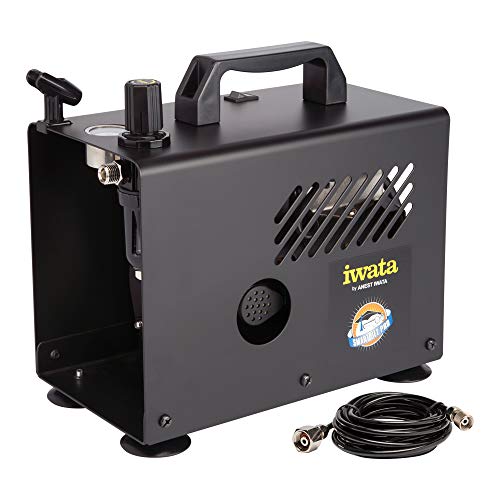
4 Iwata Smart Jet Pro Airbrush Compressor
1/6 horsepower tank-equipped compressor with an auto shut-off and quiet operation, designed specifically for single-airbrush hobby and art use.
Best for Painters who want a purpose-built hobby compressor that delivers stable pressure without workshop-level noise.
5 Master Airbrush TC-20 Tankless Compressor
Entry-level tankless compressor that delivers adjustable pressure from 0 to 57 psi, a practical starting point for painters buying their first airbrush setup.
Best for Painters buying their first compressor who want to learn airbrushing before committing to a premium compressor.
The method
How we chose
We evaluated each option on fit, build quality, daily usability, and value. Our top pick, Iwata Eclipse HP-CS Airbrush, earned the spot. The best airbrush for miniature painting at any skill level, the investment that does not require an upgrade. The comparison above highlights exactly who each pick is best for.
Related guides
Head-to-head comparisons
FAQ
Best Airbrush for Miniature Painting: FAQ
What nozzle size is best for airbrushing miniatures?+
A 0.3mm or 0.35mm nozzle is the sweet spot for miniature painting. It is fine enough for detail work and smooth gradients on 28mm scale models, while being wide enough to avoid constant clogs when thinned paint has even small particles. A 0.2mm nozzle is useful for fine detail but clogs more easily and demands very clean, heavily thinned paint. A 0.5mm nozzle is better for terrain and large models but too coarse for blending on standard miniatures.
Do I need a tank compressor for airbrushing miniatures?+
A tank-equipped compressor is strongly recommended. The tank smooths out the pressure pulsation that oil-less piston compressors produce when running continuously, which shows up as a stuttering, grainy finish on smooth gradients. A tankless compressor works and is cheaper, but the pulsation is noticeable. If you are serious about airbrushing, the tank is worth the extra cost from the start rather than upgrading later.
What paints work in an airbrush for miniatures?+
Airbrush-ready formulas like Vallejo Model Air, AK Interactive Air Series, and Scale75 Air Color are designed for the airbrush and need no thinning. Standard acrylics like Citadel and Vallejo Game Color work but must be thinned to a consistency like skimmed milk, roughly 1:1 with water or a dedicated airbrush medium. Adding a flow improver like Liquitex Airbrush Medium helps paint move through the brush without drying in the needle.
How do I clean an airbrush after using miniature paints?+
Flush the cup with clean water between colours and at the end of a session, then run a few drops of airbrush cleaner through on a medium-flow setting until it runs clear. Disassemble the needle and nozzle weekly and clean with a cotton swab dipped in cleaner. Dried paint in the nozzle is the most common cause of splattering and tip dry; regular flushing prevents most of it. A full strip-down and soak in airbrush cleaner every few months keeps the brush performing like new.